I Watched the Meter Run
What my own divorce taught me about the economics of hourly billing—and why I built a firm that refuses to do it.
There is a particular kind of anxiety that only people who have been billed by the hour during a divorce will understand. It is the feeling of your phone buzzing with a text from your attorney and knowing—before you even read it—that this message just cost you somewhere between $50 and $100. That a four-minute phone call to clarify a single date on a financial disclosure will show up on next month's invoice as 0.2 hours. That every email you send, no matter how brief, starts a clock you cannot see and cannot stop.
I lived with that feeling for over a year.
I am a lawyer. I understand billing. I understand retainers, engagement letters, and the difference between a quarter-hour increment and a tenth-of-an-hour increment. And still, when I was the client—when it was my marriage, my finances, my future being metered out in six-minute blocks—I found the experience disorienting, adversarial in a way that had nothing to do with my ex-spouse, and structurally designed to make the worst period of my life last longer than it needed to.
The Realization
The moment that changed how I think about legal fees came about eight months in. My attorney had filed a motion that I hadn't asked for. It wasn't frivolous—there was a colorable argument behind it—but it wasn't necessary either. It was the kind of motion that a careful attorney might file to cover every angle, or that a busy attorney might file because drafting motions is what attorneys do. The bill for that motion, including research, drafting, filing, and a hearing I attended in person, was roughly $4,200.
I remember sitting with that invoice and doing a calculation I had never done before: what would my attorney have done differently if she were paying for this out of her own pocket?
The answer was obvious. She wouldn't have filed it.
The hourly billing model doesn't just misalign incentives. It inverts them. Your attorney's best financial outcome is your worst personal outcome: a case that drags on, escalates, and never settles.
That realization—that the person I was paying to end my divorce had a structural financial interest in prolonging it—was not a failure of character. My attorney was competent and professional. The problem was the system.
The Numbers Are Unforgiving
After my divorce was finalized, I ran the numbers the way I would run them for a client in a real estate transaction. Total fees: well into the five figures. Total billable hours: enough to represent a part-time job. Average cost per month the case was active: enough to make a car payment on something European.
And here is what I kept coming back to: the longer my case lasted, the more money my attorney made. Not because she was padding hours. Not because she was acting unethically. Simply because the fee structure rewarded duration over resolution. Every additional month of negotiation, every hearing, every exchange of discovery—each one was revenue for her and cost for me.
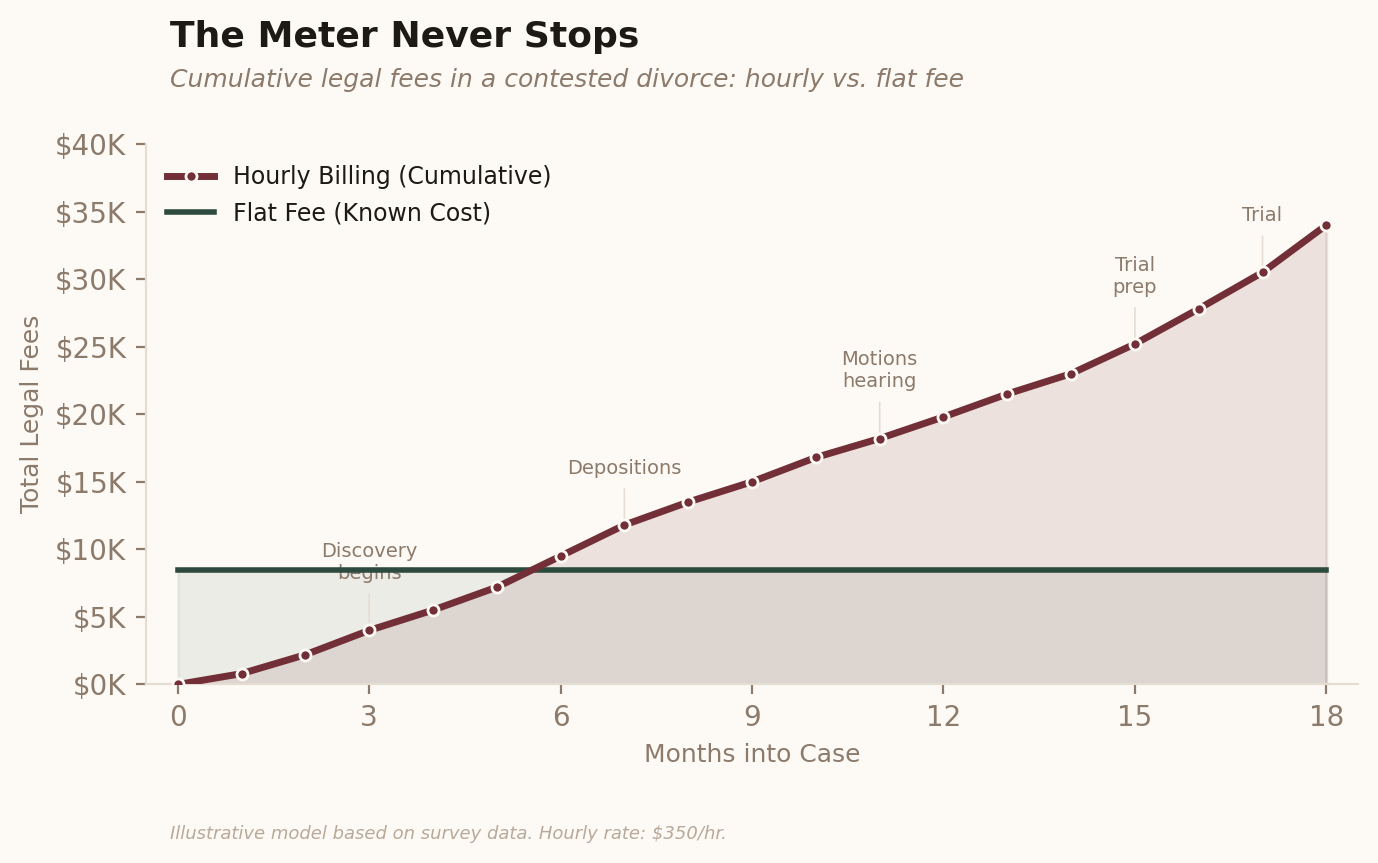
Hourly billing produces an accelerating cost trajectory. As a case moves through discovery, depositions, motions practice, and trial preparation, the hours compound. Under a flat fee, the client knows the cost from day one. Under hourly billing, the cost is unknowable until the case is over—and by then, it is too late to do anything about it.
Why I Built a Different Kind of Firm
I founded Kynigos Law Firm on a principle that came directly from this experience: an attorney should never profit from prolonging a client's problem. In family matters, our fees are flat—a fixed price for defined work. Not as a marketing gimmick. Not as a discount strategy. As an alignment mechanism.
When your attorney's fee is fixed, every unnecessary motion is a cost your attorney bears, not you. Every hour spent on marginal research is an hour that reduces your attorney's effective rate, not an hour that inflates your bill. The incentive structure flips: your attorney is now rewarded for efficiency, strategic thinking, and early resolution.
Economists have a name for this. They call it solving the principal-agent problem. I just call it practicing law the way it should be practiced.
And this preference is not unique to me. When legal consumers are surveyed about how they want to pay, they consistently favor flat, predictable pricing:
for their entire case
for individual tasks
legal work since 2016
Source: Clio, 2024 Legal Trends Report.
Related practice area: Family Law
Kynigos Law Firm, PLLC · Washington, DC · Licensed in the District of Columbia. This article is for informational purposes only and does not constitute legal advice. Results may vary depending on your particular facts and legal circumstances.